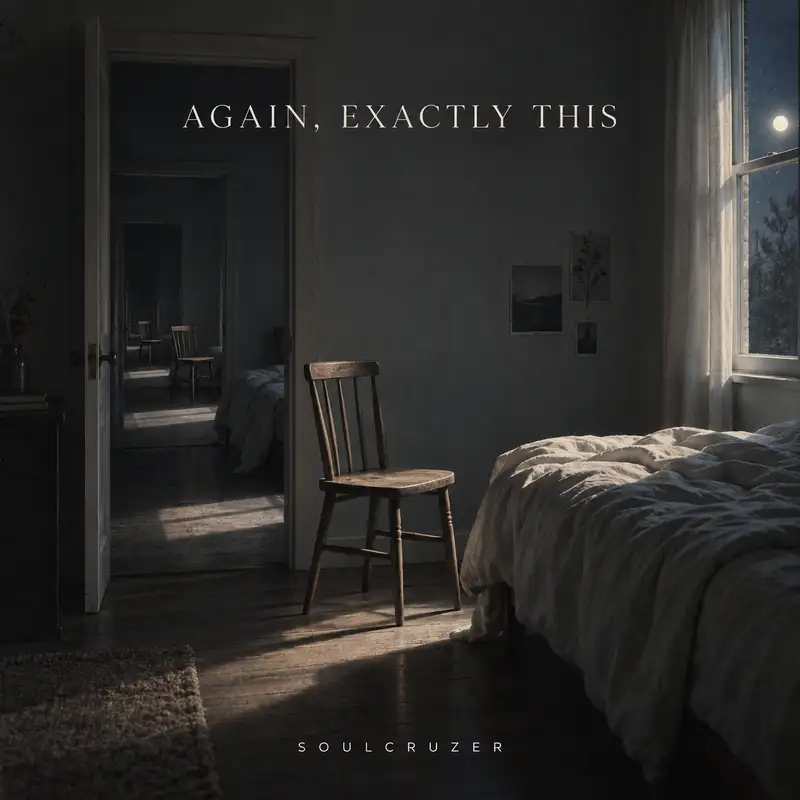
Again, Exactly This
Again, Exactly This
There’s a line in the song where a stranger pulls an empty chair beside the bed. It’s three in the morning, that hour when the things you’ve managed to avoid all day start making themselves comfortable.
He brings an unsettling proposition: you’ll live this life again. The whole thing. The broken cup, the unanswered call, the clumsy kiss. You’ll return to the moments you treasure and the ones you still rehearse in your head, trying to find the sentence you should have said.
And you won’t get to change the ending.
That’s the thought at the centre of Again, Exactly This, an alternative rock song I made with Suno around Nietzsche’s idea of eternal recurrence.
The life you’d have to repeat
Imagine having to live your life again, exactly as it happened, an endless number of times.
Spend a moment with that before trying to answer it.
I suspect most of us would start editing. We’d agree to another run if we could fix a few things first. Make the call. Leave sooner. Stay longer. Stop ourselves halfway through the sentence that damaged something we loved.
I recognise that impulse. There’s a better version of my life I can visit in my imagination, populated by better decisions and conversations in which I somehow know everything I learned afterwards. I can spend a lot of time there. It’s a comfortable place to be wise.
Eternal recurrence closes that particular escape route. The life on offer is the one you’ve actually lived.
The song brings that down to the scale of a room. A coat beside the door. Someone laughing with their mouth full. These are small things, but when you imagine losing them, they acquire weight. They belong to the same life as the regret. You can’t reach into the sequence and lift them out without disturbing everything around them.
That’s where the question starts getting difficult.
A yes that catches in the throat
I wanted the song to resist an easy reconciliation.
There’s something troubling about the speed with which we turn suffering into a lesson. Give it enough distance and we start arranging it into a story about growth. Sometimes that story helps. Sometimes we use it to cover something that still hurts.
So the bridge pushes back:
Don’t tell me pain was worth the price
I know the names of those I miss.
I know the names of those I miss.
Those lines matter to me. I don’t want the song to pretend that grief becomes acceptable once we find a philosophical frame big enough to contain it. The people we miss remain people we miss. We still want them sitting in the room.
And yet the question remains: can you love this life while knowing what it contains?
The final chorus reaches for a yes, but the voice shakes. That feels closer to the difficulty of the thought. There’s fear inside the affirmation. There are things the singer would still change if changing them were possible.
The yes costs something.
Giving the thought a body
Alternative rock felt like the right place to put this question. It has room for the close, uneasy voice and the moment when that voice needs distortion behind it. A thought can sit beside your bed in the verse and become something you have to sing through in the chorus.
Repetition does some of the philosophical work, too. The same words return, carrying the pressure of what has happened between them. By the final chorus, “again” has travelled a long way from the stranger’s first announcement.
Making the song became another way of spending time with the idea. Music gives a thought duration. You have to breathe through it. You hear yourself returning to the same line and discover that you’re answering it differently.
I’m left thinking about the ordinary life we keep treating as a rough draft.
The cup on the table. The person we haven’t called. The evening we’re halfway through.
If this came round again, exactly like this, how much of it would I have been here for?